Component
VCO
v0.5.108, v0.5.109
Oscillator: the source of the tone.
Software v0.5.109
Overview
Oscillator: the source of the tone.
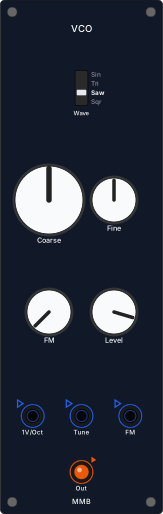
The basic oscillator of MusicBrain, and the start of most example voices: a VCO into a filter into a VCA. The Wave switch picks one of four waveforms (sine, triangle, saw or square). Coarse tunes in semitones (±36), Fine in cents (±100), and Level sets how loud it comes out.
Patch a pitch CV from MIDI-in or a sequencer into 1V/Oct: 0 V is C4 (261.6 Hz) and each volt is one octave. The Tune input adds a second pitch voltage on top, for pitch bend or detune, without overwriting the note. The FM input, scaled by the FM knob, moves the pitch in octaves: an LFO there gives vibrato. It runs at the 1 kHz control rate; for audio-rate frequency modulation use the FM-VCO.
Controls
| Control | Range | Default | What it does |
|---|---|---|---|
| Wave | Sin / Tri / Saw / Sqr | Saw | The waveform: sine, triangle, saw or square. |
| Coarse | -36 … 36 semi | 0 | Tuning in semitones, on top of the V/Oct input. |
| Fine | -100 … 100 ct | 0 | Fine tuning in cents. |
| FM | 0 … 1 | 0 | How much the FM input moves the pitch (at 1: one octave per unit). |
| Level | 0 … 1 | 0.8 | Output level. |
Ports
| Port | Direction | Signal | What it carries |
|---|---|---|---|
| 1V/Oct | in | cv | Pitch, 1 V per octave; 0 V is C4. |
| Tune | in | cv | Extra pitch in V/Oct added to the note, for bend or detune. |
| FM | in | cv | Pitch modulation: adds FM × the FM knob in octaves (1 kHz control rate, for vibrato and sweeps). |
| Out | out | audio | The oscillator. |
How it works
The oscillator is AudioSynthWaveform from the Teensy Audio Library, using
its plain (not band-limited) waveforms, so very high notes alias. The pitch
is 261.6256 Hz × 2^(V/Oct + Tune + FM × FM knob + Coarse/12 + Fine/1200),
recomputed as soon as any of these changes.
The browser simulator runs a WebAssembly copy of the same oscillator code, so the editor and the Brain behave the same.
Runs on
- Teensy 4.1 (the MusicBrain Brain): about 0.1 % CPU per instance (one note, default settings), measured on firmware 0.5.108.
- The browser: the editor's simulator runs the same C++ code as WebAssembly, so what you hear while patching is what the Brain plays.
Try it
Patches to play (open them in the editor from their page): 6-stemmig ladder-filter.
In the editor's example set: 1-stemmig (mono), 2-stemmig, 4-stemmig, 8-stemmig, 16-stemmig, 4-stemmig + aftertouch → filter, 🎺 CS-80 brass (aftertouch), 🎹 Axel F-lead (2 saws), Reservoir demo (gedeelde bron), 🌊 West Coast (Turing + Folder + LPG), 🎚️ SEM sweep (LP → notch → HP), 🎺 CS-80 brass ×4, 🎸 Axel F lead, 🌊 West Coast.
Editor: https://editor.musicbrain.nl
Sources & licences
- Oscillator:
AudioSynthWaveformfrom the Teensy Audio Library by PJRC (MIT licence). - The MusicBrain module code is MIT licensed.
Versions
- 0.5.109: the FM input and FM knob work; the Sync input, which never did anything, is gone.
- 0.5.93: Coarse and Fine retune at once (they used to wait for the next V/Oct change); unplugging the V/Oct cable returns the pitch to C4.
- Simulator (September 2026): the browser plays the firmware oscillator as WebAssembly.
- May 2026: Tune input, so pitch bend no longer overwrites the note.
- First version (May 2026): wave, coarse, fine and level.
Earlier versions (1)v0.5.108
Software v0.5.108
Overview
Oscillator: the source of the tone.
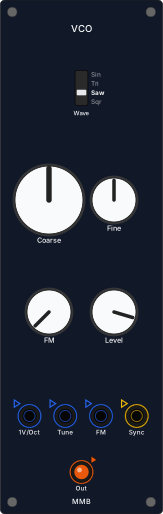
The basic oscillator of MusicBrain, and the start of most example voices: a VCO into a filter into a VCA. The Wave switch picks one of four waveforms (sine, triangle, saw or square). Coarse tunes in semitones (±36), Fine in cents (±100), and Level sets how loud it comes out.
Patch a pitch CV from MIDI-in or a sequencer into 1V/Oct: 0 V is C4 (261.6 Hz) and each volt is one octave. The Tune input adds a second pitch voltage on top, for pitch bend or detune, without overwriting the note. The FM and Sync inputs and the FM knob are on the panel but do nothing yet, on the Teensy or in the simulator; for frequency modulation use the FM-VCO.
Controls
| Control | Range | Default | What it does |
|---|---|---|---|
| Wave | Sin / Tri / Saw / Sqr | Saw | The waveform: sine, triangle, saw or square. |
| Coarse | -36 … 36 semi | 0 | Tuning in semitones, on top of the V/Oct input. |
| Fine | -100 … 100 ct | 0 | Fine tuning in cents. |
| FM | 0 … 1 | 0 | FM depth; the FM input is not wired up yet in this module (use the FM-VCO for FM). |
| Level | 0 … 1 | 0.8 | Output level. |
Ports
| Port | Direction | Signal | What it carries |
|---|---|---|---|
| 1V/Oct | in | cv | Pitch, 1 V per octave; 0 V is C4. |
| Tune | in | cv | Extra pitch in V/Oct added to the note, for bend or detune. |
| FM | in | cv | Frequency modulation input; not implemented yet. |
| Sync | in | trigger | Hard sync input; not implemented yet. |
| Out | out | audio | The oscillator. |
How it works
The oscillator is AudioSynthWaveform from the Teensy Audio Library, using
its plain (not band-limited) waveforms, so very high notes alias. The pitch
is 261.6256 Hz × 2^(V/Oct + Tune + Coarse/12 + Fine/1200), recomputed as
soon as any of these changes.
The browser simulator runs a WebAssembly copy of the same oscillator code, including the inputs that are not implemented yet, so the editor and the Brain behave the same.
Runs on
- Teensy 4.1 (the MusicBrain Brain): about 0.1 % CPU per instance (one note, default settings), measured on firmware 0.5.108.
- The browser: the editor's simulator runs the same C++ code as WebAssembly, so what you hear while patching is what the Brain plays.
Try it
Patches to play (open them in the editor from their page): 6-stemmig ladder-filter.
In the editor's example set: 1-stemmig (mono), 2-stemmig, 4-stemmig, 8-stemmig, 16-stemmig, 4-stemmig + aftertouch → filter, 🎺 CS-80 brass (aftertouch), 🎹 Axel F-lead (2 saws), Reservoir demo (gedeelde bron), 🌊 West Coast (Turing + Folder + LPG), 🎚️ SEM sweep (LP → notch → HP), 🎺 CS-80 brass ×4, 🎸 Axel F lead, 🌊 West Coast.
Editor: https://editor.musicbrain.nl
Sources & licences
- Oscillator:
AudioSynthWaveformfrom the Teensy Audio Library by PJRC (MIT licence). - The MusicBrain module code is MIT licensed.
Versions
- 0.5.93: Coarse and Fine retune at once (they used to wait for the next V/Oct change); unplugging the V/Oct cable returns the pitch to C4.
- Simulator (September 2026): the browser plays the firmware oscillator as WebAssembly.
- May 2026: Tune input, so pitch bend no longer overwrites the note.
- First version (May 2026): wave, coarse, fine and level.