Component
Plaits macro oscillator
v0.5.108, v0.5.110
Oscillators & voicesMutable Instruments
A macro oscillator (Mutable Instruments Plaits): 24 sound models.
Software v0.5.110
Overview
A macro oscillator (Mutable Instruments Plaits): 24 sound models.
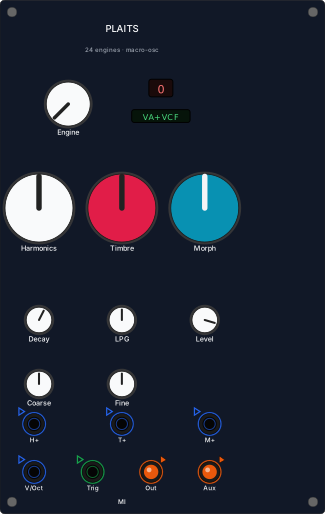
A port of Mutable Instruments Plaits: one oscillator module with 24 sound models behind a single Engine knob, from virtual analogue and six-operator FM to chords, speech, physical models and drums. The display shows the name of the chosen engine. Harmonics, Timbre and Morph do something different in each engine; Decay and LPG set the built-in low-pass gate.
Patch pitch into V/Oct and a gate or trigger into Trig: each rising edge strikes the low-pass gate, and the drum and physical-model engines use it as their hit. Out is the main sound, Aux a variant that depends on the engine. H+, T+ and M+ add to their knob; ±1 sweeps the whole range. The Speech engine (15) needs Trig patched; Harmonics then picks the speech model, Morph the vowel or word, and Timbre shifts the formants.
Controls
| Control | Range | Default | What it does |
|---|---|---|---|
| Engine | 0 … 23 | 0 | Picks the sound model; the display shows its name. |
| Harmonics | 0 … 1 | 0.5 | First macro: different per model, often the overtones. |
| Timbre | 0 … 1 | 0.5 | Second macro: often the brightness. |
| Morph | 0 … 1 | 0.5 | Third macro: often the shape or the blend. |
| Decay | 0 … 1 | 0.6 | How long a struck note rings on. |
| LPG | 0 … 1 | 0.5 | Colour of the low-pass gate: from more filter to more volume. |
| Level | 0 … 1 | 0.8 | Output level. |
| Coarse | -36 … 36 semi | 0 | Tuning in semitones. |
| Fine | -100 … 100 ct | 0 | Fine tuning in cents. |
Ports
| Port | Direction | Signal | What it carries |
|---|---|---|---|
| H+ | in | cv | Adds to the Harmonics knob; ±1 sweeps its whole range. |
| T+ | in | cv | Adds to the Timbre knob; ±1 sweeps its whole range. |
| M+ | in | cv | Adds to the Morph knob; ±1 sweeps its whole range. |
| V/Oct | in | cv | Pitch, 1 V per octave; 0 V is C4. |
| Trig | in | gate | Trig: each rising edge strikes the low-pass gate and the percussive engines. |
| Out | out | audio | The main sound. |
| Aux | out | audio | A variant of the sound, different per engine. |
How it works
The module runs the Plaits 1.2 code as it is. The engine number is the order in which Plaits 1.2 registers its engines: 0 VA+VCF, 1 phase distortion, 2–4 six-operator FM, 5 wave terrain, 6 string machine, 7 chiptune, 8 VA, 9 waveshaping, 10 two-operator FM, 11 grain, 12 additive, 13 wavetable, 14 chord, 15 speech, 16 swarm, 17 noise, 18 particle, 19 string, 20 modal, 21 bass drum, 22 snare, 23 hi-hat.
Plaits renders at 48 kHz; the wrapper resamples linearly to 44.1 kHz. Its working memory is one 16 KB block on the heap. On the Teensy the Plaits code and tables run from the external (cached) flash, because they did not fit in fast RAM, and the module zeroes its memory before use as the original code expects. The browser simulator compiles the same code to WebAssembly.
Runs on
- Teensy 4.1 (the MusicBrain Brain): about 7.5 % CPU per instance (one note, default settings), measured on firmware 0.5.108.
- The browser: the editor's simulator runs the same C++ code as WebAssembly, so what you hear while patching is what the Brain plays.
Try it
In the editor's example set: 🎛️ Plaits (24 engines), 🎚️ Plaits + VCA-bus, 🎚️ Plaits + Para EQ, 🔁 Plaits + Stereo tape, 🎶 Plaits + Harmonizer, 🌀 Plaits + Stereo phaser, ☁️ Clouds ambient (+Tides), 🎲 Generative jam (Marbles), 🗣️ Warps vocoder, 🎶 Koor zingt woorden (vocoder), 🎲 Generative jam.
Editor: https://editor.musicbrain.nl
Sources & licences
- Based on Mutable Instruments Plaits (firmware 1.2) by Émilie Gillet, open
source under the MIT licence (vendored in
firmware/lib/mi-plaits). - The MusicBrain wrapper is MIT licensed as well. This is a software port, not the Mutable Instruments hardware.
Versions
- 0.5.110: the CV inputs add to their knob instead of replacing it.
- October 2026 (editor): the engine name is shown next to the number.
- 0.5.90: engine numbering corrected and all 24 engines reachable (the knob stopped at 15 and used the old list of 16 names); existing patches sound the same.
- Simulator (September 2026): the browser runs the same Plaits code as WebAssembly.
- 0.5.29: first version (July 2026).
Earlier versions (1)v0.5.108
Software v0.5.108
Overview
A macro oscillator (Mutable Instruments Plaits): 24 sound models.
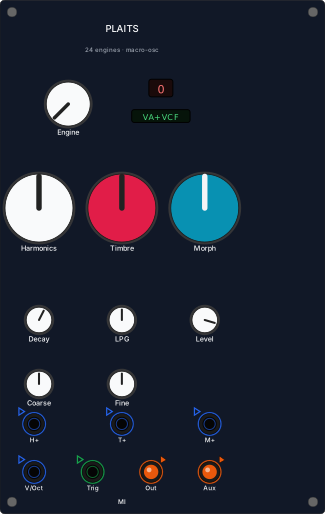
A port of Mutable Instruments Plaits: one oscillator module with 24 sound models behind a single Engine knob, from virtual analogue and six-operator FM to chords, speech, physical models and drums. The display shows the name of the chosen engine. Harmonics, Timbre and Morph do something different in each engine; Decay and LPG set the built-in low-pass gate.
Patch pitch into V/Oct and a gate or trigger into Trig: each rising edge strikes the low-pass gate, and the drum and physical-model engines use it as their hit. Out is the main sound, Aux a variant that depends on the engine. H+, T+ and M+ take over their knob while patched (0 to 1). The Speech engine (15) needs Trig patched; Harmonics then picks the speech model, Morph the vowel or word, and Timbre shifts the formants.
Controls
| Control | Range | Default | What it does |
|---|---|---|---|
| Engine | 0 … 23 | 0 | Picks the sound model; the display shows its name. |
| Harmonics | 0 … 1 | 0.5 | First macro: different per model, often the overtones. |
| Timbre | 0 … 1 | 0.5 | Second macro: often the brightness. |
| Morph | 0 … 1 | 0.5 | Third macro: often the shape or the blend. |
| Decay | 0 … 1 | 0.6 | How long a struck note rings on. |
| LPG | 0 … 1 | 0.5 | Colour of the low-pass gate: from more filter to more volume. |
| Level | 0 … 1 | 0.8 | Output level. |
| Coarse | -36 … 36 semi | 0 | Tuning in semitones. |
| Fine | -100 … 100 ct | 0 | Fine tuning in cents. |
Ports
| Port | Direction | Signal | What it carries |
|---|---|---|---|
| H+ | in | cv | Sets Harmonics (0 to 1) while patched. |
| T+ | in | cv | Sets Timbre (0 to 1) while patched. |
| M+ | in | cv | Sets Morph (0 to 1) while patched. |
| V/Oct | in | cv | Pitch, 1 V per octave; 0 V is C4. |
| Trig | in | gate | Trig: each rising edge strikes the low-pass gate and the percussive engines. |
| Out | out | audio | The main sound. |
| Aux | out | audio | A variant of the sound, different per engine. |
How it works
The module runs the Plaits 1.2 code as it is. The engine number is the order in which Plaits 1.2 registers its engines: 0 VA+VCF, 1 phase distortion, 2–4 six-operator FM, 5 wave terrain, 6 string machine, 7 chiptune, 8 VA, 9 waveshaping, 10 two-operator FM, 11 grain, 12 additive, 13 wavetable, 14 chord, 15 speech, 16 swarm, 17 noise, 18 particle, 19 string, 20 modal, 21 bass drum, 22 snare, 23 hi-hat.
Plaits renders at 48 kHz; the wrapper resamples linearly to 44.1 kHz. Its working memory is one 16 KB block on the heap. On the Teensy the Plaits code and tables run from the external (cached) flash, because they did not fit in fast RAM, and the module zeroes its memory before use as the original code expects. The browser simulator compiles the same code to WebAssembly.
Runs on
- Teensy 4.1 (the MusicBrain Brain): about 7.5 % CPU per instance (one note, default settings), measured on firmware 0.5.108.
- The browser: the editor's simulator runs the same C++ code as WebAssembly, so what you hear while patching is what the Brain plays.
Try it
In the editor's example set: 🎛️ Plaits (24 engines), 🎚️ Plaits + VCA-bus, 🎚️ Plaits + Para EQ, 🔁 Plaits + Stereo tape, 🎶 Plaits + Harmonizer, 🌀 Plaits + Stereo phaser, ☁️ Clouds ambient (+Tides), 🎲 Generative jam (Marbles), 🗣️ Warps vocoder, 🎶 Koor zingt woorden (vocoder), 🎲 Generative jam.
Editor: https://editor.musicbrain.nl
Sources & licences
- Based on Mutable Instruments Plaits (firmware 1.2) by Émilie Gillet, open
source under the MIT licence (vendored in
firmware/lib/mi-plaits). - The MusicBrain wrapper is MIT licensed as well. This is a software port, not the Mutable Instruments hardware.
Versions
- October 2026 (editor): the engine name is shown next to the number.
- 0.5.90: engine numbering corrected and all 24 engines reachable (the knob stopped at 15 and used the old list of 16 names); existing patches sound the same.
- Simulator (September 2026): the browser runs the same Plaits code as WebAssembly.
- 0.5.29: first version (July 2026).