Component
LFO
v0.5.108, v0.5.109
A slow oscillator for movement (vibrato, wah, sweep).
Software v0.5.109
Overview
A slow oscillator for movement (vibrato, wah, sweep).
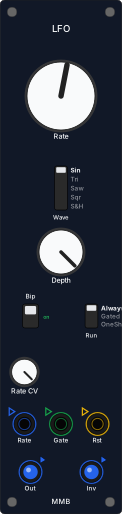
A low-frequency oscillator with five waves: sine, triangle, saw, square and sample & hold (a new random value each cycle). Use it for vibrato on a pitch, a slow filter sweep, tremolo on a VCA or a random wobble.
Bip on gives a signal around zero (−Depth … +Depth), right for pitch and filter. Bip off gives 0 … Depth, right for a VCA or anything that should only go up. Inv is the same signal upside down, so one VCA can rise while another falls. A pulse on Rst starts the cycle again, to keep several LFOs in step.
Run chooses when it moves: Always runs freely, Gated only while the Gate input is high, OneShot runs one cycle on each rising edge at Gate and then stops — a simple extra envelope.
Controls
| Control | Range | Default | What it does |
|---|---|---|---|
| Rate | 0.01 … 50 Hz | 1 | How fast. |
| Wave | Sin / Tri / Saw / Sqr / S&H | Sin | Sine, triangle, saw, square, or sample & hold (a random value per cycle). |
| Depth | 0 … 1 | 1 | How deep. |
| Bip | off / on | on | On: −Depth … +Depth. Off: 0 … Depth. |
| Run | Always / Gated / OneShot | Always | Always runs freely; Gated runs only while Gate is high; OneShot runs one cycle per rising edge on Gate. |
| Rate CV | -1 … 1 | 1 | How much the Rate input changes the speed; at 1, ±1 CV is ±4 octaves; below 0 inverted. |
Ports
| Port | Direction | Signal | What it carries |
|---|---|---|---|
| Rate | in | cv | Speed modulation, exponential: +1 is four octaves faster at Rate CV 1. |
| Gate | in | gate | Gate for the Gated and OneShot run modes. |
| Rst | in | trigger | A rising edge restarts the cycle. |
| Out | out | cv | The LFO signal. |
| Inv | out | cv | The same signal upside down. |
How it works
The LFO runs at the control rate of 1 kHz. Rate is set in hertz (0.01 … 50 Hz on the knob). The Rate input bends the speed exponentially: with the Rate CV knob at 1, +1 on the input makes the LFO 16 times faster (four octaves) and −1 16 times slower; 0 ignores the input and negative values turn it round.
The sample & hold value comes from a small pseudo-random generator and changes once per cycle.
Runs on
- Teensy 4.1 (the MusicBrain Brain): less than 0.1 % CPU per instance, measured on firmware 0.5.108.
- The browser: the editor's simulator runs the same C++ code as WebAssembly, so what you hear while patching is what the Brain plays.
Try it
Patches to play (open them in the editor from their page): 6-stemmig ladder-filter, SID piano (AT vibrato + comp + studio buizen).
In the editor's example set: 1-stemmig (mono), 2-stemmig, 4-stemmig, 8-stemmig, 16-stemmig, 4-stemmig + aftertouch → filter, 🎺 CS-80 brass (aftertouch), 🎹 Axel F-lead (2 saws), 🕹️ SID ×3 (C64), 🕹️ SID ×6 (2 chips, stereo), 🕹️ SID ×9 (3 chips, stereo), 🕹️ SID ×12 (4 chips, stereo), 🎧 Sampler ×8 (cellen), 🎧 Sampler ×8 auto-wah, 🎧 Sampler ×8 auto-wah + FET, 🎧 Sampler ×8 + EQ + Vari-mu, 🎺 CS-80 brass ×4, 🎸 Axel F lead, 👾 SID ×3.
Editor: https://editor.musicbrain.nl
Sources & licences
- Our own code, MIT licence.
Versions
- 0.5.109: Gate input on the panel, so Gated and OneShot work (before, those modes waited for an input that was not there).
- 0.5.82: attenuverter on the Rate input (Rate CV, −1 … +1).
- First version (May 2026): five waves, depth, bipolar or unipolar, rate CV, reset and an inverted output.
Earlier versions (1)v0.5.108
Software v0.5.108
Overview
A slow oscillator for movement (vibrato, wah, sweep).
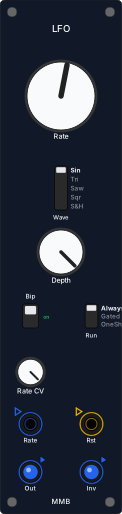
A low-frequency oscillator with five waves: sine, triangle, saw, square and sample & hold (a new random value each cycle). Use it for vibrato on a pitch, a slow filter sweep, tremolo on a VCA or a random wobble.
Bip on gives a signal around zero (−Depth … +Depth), right for pitch and filter. Bip off gives 0 … Depth, right for a VCA or anything that should only go up. Inv is the same signal upside down, so one VCA can rise while another falls. A pulse on Rst starts the cycle again, to keep several LFOs in step.
Controls
| Control | Range | Default | What it does |
|---|---|---|---|
| Rate | 0.01 … 50 Hz | 1 | How fast. |
| Wave | Sin / Tri / Saw / Sqr / S&H | Sin | Sine, triangle, saw, square, or sample & hold (a random value per cycle). |
| Depth | 0 … 1 | 1 | How deep. |
| Bip | off / on | on | On: −Depth … +Depth. Off: 0 … Depth. |
| Run | Always / Gated / OneShot | Always | Always runs freely; Gated and OneShot wait for a gate input that the panel does not have yet. |
| Rate CV | -1 … 1 | 1 | How much the Rate input changes the speed; at 1, ±1 CV is ±4 octaves; below 0 inverted. |
Ports
| Port | Direction | Signal | What it carries |
|---|---|---|---|
| Rate | in | cv | Speed modulation, exponential: +1 is four octaves faster at Rate CV 1. |
| Rst | in | trigger | A rising edge restarts the cycle. |
| Out | out | cv | The LFO signal. |
| Inv | out | cv | The same signal upside down. |
How it works
The LFO runs at the control rate of 1 kHz. Rate is set in hertz (0.01 … 50 Hz on the knob). The Rate input bends the speed exponentially: with the Rate CV knob at 1, +1 on the input makes the LFO 16 times faster (four octaves) and −1 16 times slower; 0 ignores the input and negative values turn it round.
The sample & hold value comes from a small pseudo-random generator and changes once per cycle.
Runs on
- Teensy 4.1 (the MusicBrain Brain): less than 0.1 % CPU per instance, measured on firmware 0.5.108.
- The browser: the editor's simulator runs the same C++ code as WebAssembly, so what you hear while patching is what the Brain plays.
Try it
Patches to play (open them in the editor from their page): 6-stemmig ladder-filter, SID piano (AT vibrato + comp + studio buizen).
In the editor's example set: 1-stemmig (mono), 2-stemmig, 4-stemmig, 8-stemmig, 16-stemmig, 4-stemmig + aftertouch → filter, 🎺 CS-80 brass (aftertouch), 🎹 Axel F-lead (2 saws), 🕹️ SID ×3 (C64), 🕹️ SID ×6 (2 chips, stereo), 🕹️ SID ×9 (3 chips, stereo), 🕹️ SID ×12 (4 chips, stereo), 🎧 Sampler ×8 (cellen), 🎧 Sampler ×8 auto-wah, 🎧 Sampler ×8 auto-wah + FET, 🎧 Sampler ×8 + EQ + Vari-mu, 🎺 CS-80 brass ×4, 🎸 Axel F lead, 👾 SID ×3.
Editor: https://editor.musicbrain.nl
Sources & licences
- Our own code, MIT licence.
Versions
- 0.5.82: attenuverter on the Rate input (Rate CV, −1 … +1).
- First version (May 2026): five waves, depth, bipolar or unipolar, rate CV, reset and an inverted output.