Component
Complex oscillator
v0.5.108
Oscillators & voicesOversampled
A complex oscillator (Buchla 259): overtones from FM and folding instead of a filter.
Software v0.5.108
Overview
A complex oscillator (Buchla 259): overtones from FM and folding instead of a filter.
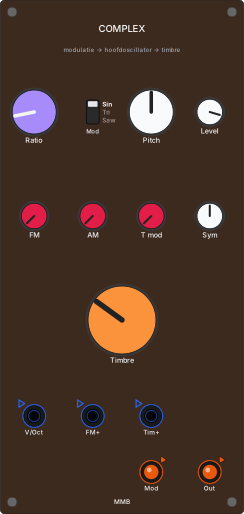
Two oscillators in one module, modelled on the Buchla 259. A modulation oscillator (sine, triangle or saw, at Ratio times the main pitch) works on the main oscillator in three ways at once, each with its own amount: FM bends the pitch, AM changes how hard the sine drives the folder, and T mod moves the folder itself. Whole-number ratios stay harmonic; in between the sound turns bell-like.
The main oscillator is a sine that goes through a wavefolder: Timbre at 0 is a pure sine, turning it up folds the wave and adds overtones; Sym adds even overtones. This is the West Coast way of making a bright sound without a filter. Put an envelope on Tim+ for a brighter attack and another on FM+, and follow it with a low-pass gate (Solo ▾ → Buchla voice does exactly that). The Mod output gives the modulation oscillator on its own.
Controls
| Control | Range | Default | What it does |
|---|---|---|---|
| Ratio | 0.01 … 16 | 2 | Frequency of the modulation oscillator, as a multiple of the pitch (0.01–16). |
| Mod | Sin / Tri / Saw | Sin | Waveform of the modulation oscillator: sine, triangle or saw. |
| Pitch | -48 … 48 semi | 0 | Tuning in semitones. |
| Level | 0 … 1 | 0.8 | Output level. |
| FM | 0 … 1 | 0 | How much the second oscillator modulates the pitch. |
| AM | 0 … 1 | 0 | How much the modulation oscillator changes the level going into the folder. |
| T mod | 0 … 1 | 0 | How much the modulation oscillator moves the folder. |
| Sym | -1 … 1 | 0 | Adds even overtones. |
| Timbre | 0 … 1 | 0.3 | How far the wave is folded: 0 = pure sine, further = more overtones. |
Ports
| Port | Direction | Signal | What it carries |
|---|---|---|---|
| V/Oct | in | cv | Pitch, 1 V per octave; 0 V is C4. |
| FM+ | in | cv | Added to the FM amount. |
| Tim+ | in | cv | Added to Timbre: an envelope here gives a brighter attack. |
| Mod | out | audio | The modulation oscillator on its own. |
| Out | out | audio | The main oscillator after the folder. |
How it works
The modulation oscillator runs at Ratio × the main frequency (Ratio 0.01 to 16). FM is linear and through zero: the FM amount, squared, sets an index of up to six times the fundamental. AM scales the sine before the folder; at full depth its level swings between full and zero with the modulator. The folder is the five-cell model of the 259 timbre circuit (the same shape as the 259 setting of the Folder module): its gain is 1 + 12 × Timbre², T mod and Tim+ move Timbre, and Sym adds an offset before folding. The folding runs at four times the sample rate, and a 12 Hz high-pass removes the DC that Sym leaves behind.
The Teensy and the browser simulator run the same C++ kernel
(mmb_dsp/complex_osc.h).
Runs on
- Teensy 4.1 (the MusicBrain Brain): about 9.5 % CPU per instance (one note, default settings), measured on firmware 0.5.108.
- The browser: the editor's simulator runs the same C++ code as WebAssembly, so what you hear while patching is what the Brain plays.
Try it
In the editor's example set: 🎛️ Buchla-stem (Complex + LPG), 🧪 Buchla voice.
Editor: https://editor.musicbrain.nl
Sources & licences
- The five folding cells follow the piecewise-linear model of the Buchla 259 timbre circuit by F. Esqueda, H. Pöntynen, J. D. Parker and S. Bilbao, "Virtual Analog Buchla 259 Wavefolder", Proc. DAFx-17, Edinburgh, 2017.
- Our own code (
mmb_dsp/complex_osc.h,mmb_dsp/wavefolder.h), MIT licensed. Buchla is the name of its owner; this module is modelled on the 259, not a copy of it.
Versions
- 0.5.107: lighter on the Teensy, thanks to a 3.8 × faster shared oversampling filter.
- First version (October 2026): FM, AM and timbre modulation, three modulator waveforms, four times oversampled.