Component
Beads texture synthesizer
v0.5.112
Delay & reverbMutable InstrumentsStereo
Beads (Mutable): cuts what comes in into grains, or turns into a delay or a sound source.
Software v0.5.112
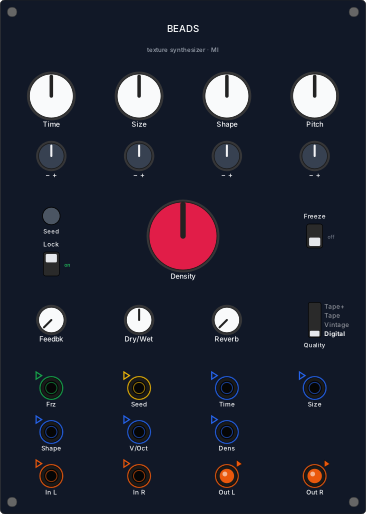
Overview
Beads (Mutable): cuts what comes in into grains, or turns into a delay or a sound source.
Beads is the successor to Clouds: it records what comes in and plays it back as grains. Time picks where in the recording the grains start, Size how long they last, Shape their envelope (from a click via soft to reversed) and Pitch their transposition, with resting points at the fifth and octave. Under each of the four sits an attenuverter: with a cable it scales the CV, without one it adds randomness. Density in the middle sets how many grains: random ones to the right, regular ones to the left, none at noon.
Turn Size fully clockwise and Beads becomes a delay and looper: Time sets the delay time, Density the rhythm of the repeats. Patch nothing into the inputs and it turns into a sound source, playing grains from built-in wavetables. Quality picks the medium: dirty tape (24 kHz, µ-law), clean tape, vintage digital (12 bit, 32 kHz) or digital.
Controls
| Control | Range | Default | What it does |
|---|---|---|---|
| Time | 0 … 1 | 0.5 | Where grains start in the recording (further back to the right); in delay mode the delay time. |
| Size | 0 … 1 | 0.5 | How long a grain lasts; fully open it becomes a delay. |
| Shape | 0 … 1 | 0.5 | The shape of a grain: from a click via soft to reversed. |
| Pitch | 0 … 1 | 0.5 | Pitch of the grains, with resting points at the fifth and octave. |
| Time CV/random | -1 … 1 | 0 | Attenuverter for Time: with a cable it scales the CV, without one it adds randomness. |
| Size CV/random | -1 … 1 | 0 | Attenuverter for Size: CV depth with a cable, randomness without. |
| Shape CV/random | -1 … 1 | 0 | Attenuverter for Shape: CV depth with a cable, randomness without. |
| Pitch CV/random | -1 … 1 | 0 | Attenuverter for Pitch: CV depth with a cable, randomness without. |
| Seed | Plays one grain (with Lock off). | ||
| Lock | off / on | on | On: grains come by themselves (default). Off: one grain per press or trigger. |
| Density | 0 … 1 | 0.5 | How many grains: random to the right, regular to the left, none in the middle. |
| Freeze | off / on | off | Holds the recording: the grains play what is in it now. |
| Feedbk | 0 … 1 | 0 | How much of the output goes back into the buffer. |
| Dry/Wet | 0 … 1 | 0.5 | Dry or wet. |
| Reverb | 0 … 1 | 0 | The built-in reverb. |
| Quality | Tape+ / Tape / Vintage / Digital | Digital | The medium: dirty tape, clean tape, vintage digital or digital. |
Ports
| Port | Direction | Signal | What it carries |
|---|---|---|---|
| Frz | in | gate | Gate: holds the recording while high. |
| Seed | in | trigger | Trigger: one grain, or a clock when Lock is on. |
| Time | in | cv | CV for Time, scaled by its attenuverter. |
| Size | in | cv | CV for Size, scaled by its attenuverter. |
| Shape | in | cv | CV for Shape, scaled by its attenuverter. |
| V/Oct | in | cv | Pitch, 1 V per octave, scaled by its attenuverter. |
| Dens | in | cv | CV for Density, added to the knob. |
| In L | in | audio | Audio in (left, or mono). |
| In R | in | audio | Audio in, right. |
| Out L | out | audio | Left output. |
| Out R | out | audio | Right output. |
How it works
The DSP is Émilie Gillet's original code, released on 11 October 2026 and running here a day later: a granular player with up to 32 grains reading from a 768 KB recording buffer, a multitap delay controller, a wavetable synth for when nothing is patched, wow and flutter, and a reverb. Each medium runs at its own sample rate; the module converts between that and the Brain's 44.1 kHz.
The knobs and CV inputs are read the way the hardware reads them
(beads.cc, cv_reader.h): the attenuverter law, the detune law of the Pitch
knob, and the CV ranges. SEED with Lock on (the default, as after power-up on
the original) makes grains by itself; with Lock off a grain comes per press
or per trigger, and with Lock on and a trigger patched the input becomes a
clock that Density divides. The assignable CV input of the original is not
there yet.
Runs on
- Teensy 4.1 (the MusicBrain Brain): about 12.4 % CPU per instance (one note, default settings), measured on firmware 0.5.112.
- The browser: the editor's simulator runs the same C++ code as WebAssembly, so what you hear while patching is what the Brain plays.
Try it
In the editor's example set: 🔮 Plaits + BEADS.
Editor: https://editor.musicbrain.nl
Sources & licences
- Based on Mutable Instruments Beads by Émilie Gillet, with Frédéric Meslin
and Oliver Rockstedt, open source under the MIT licence since 11 October
2026 (pichenettes/eurorack, commit d8f4739; vendored in
firmware/lib/mi-beads). This is a software port, not the Mutable Instruments hardware. - The MusicBrain wrapper (
beads_host.h) is MIT licensed as well and is shared by the Brain and the browser simulator.
Versions
- 0.5.112 (12–13 October 2026, a day after the source release): first version, with granular, delay and wavetable modes and all four media, in the browser and on the Brain. Measured on the Teensy: grains 9–17 % CPU depending on the medium and density, the wavetable mode 14 %; the delay mode is still heavy (about 55 %, 29 % on dirty tape) and is being looked into.