Component
BBD chorus
v0.5.108, v0.5.110
Modulation effects & EQStereoVintage
Analogue bucket-brigade chorus: wider and warmer.
Software v0.5.110
Overview
Analogue bucket-brigade chorus: wider and warmer.
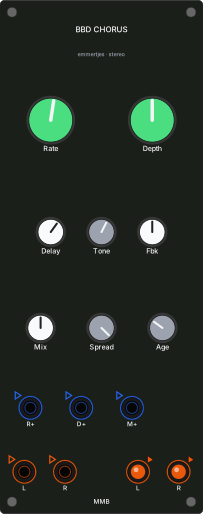
A stereo chorus and flanger in the style of the bucket-brigade (BBD) units of the late seventies, the CE-1 and Dimension family. A short delay is pulled back and forth by a slow LFO; the copy, slightly out of tune with the original, is mixed back in. Delay sets the character: 2–6 ms flanges, 8–20 ms is chorus, above 20 ms it becomes doubling.
Put it after a voice or a whole mix. A mono input gives a stereo output; with a cable in R it stays true stereo. Spread at 1 runs the two sides in opposite phase, the wide Dimension image; Fbk, positive or negative, pushes it towards a flanger.
Controls
| Control | Range | Default | What it does |
|---|---|---|---|
| Rate | 0.02 … 12 Hz | 0.6 | How fast the LFO sweeps the delay, in Hz. |
| Depth | 0 … 1 | 0.5 | How far the delay swings: up to ±60 % of Delay. |
| Delay | 0.5 … 40 ms | 8 | The centre delay: 2–6 ms flanger, 8–20 ms chorus, above 20 ms doubling. |
| Fbk | -0.95 … 0.95 | 0 | Feeds the output back in, positive or negative, for the flanger side. |
| Mix | 0 … 1 | 0.5 | How much chorus is mixed with the dry sound. |
| Spread | 0 … 1 | 1 | Phase offset of the right LFO: 0 = mono, 1 = opposite phase, the widest image. |
| Age | 0 … 1 | 0.3 | Clock noise and a harder-working compander: an older, dirtier unit. |
| Tone | 0 … 1 | 0.6 | Bandwidth of the bucket brigade: 0 = about 2 kHz (dull), 1 = 12 kHz. |
Ports
| Port | Direction | Signal | What it carries |
|---|---|---|---|
| R+ | in | cv | Adds to the Rate knob; ±1 sweeps its whole range. |
| D+ | in | cv | Adds to the Depth knob; ±1 sweeps its whole range. |
| M+ | in | cv | Adds to the Mix knob; ±1 sweeps its whole range. |
| L | in | audio | Audio input, left (or mono). |
| R | in | audio | Audio input, right; leave it empty for mono in, stereo out. |
| L | out | audio | Audio output, left. |
| R | out | audio | Audio output, right. |
How it works
Each side is a delay line of up to 40 ms read by a triangle LFO with slightly rounded turning points, so they do not click. The LFO swings the delay by up to ±60 % of the centre value. The right side runs the same LFO shifted by half a cycle times Spread.
The sound of a BBD lives in the chain around the delay, and that is what is modelled: a low-pass filter at the input and the output (the anti-aliasing filters of a real chip; Tone sets their bandwidth from about 2 kHz to 12 kHz), a soft compander that saturates when you play hard, and a little clock noise. Age adds that noise and makes the compander work harder. The same C++ kernel runs on the Teensy and in the browser.
Runs on
- Teensy 4.1 (the MusicBrain Brain): about 3.8 % CPU per instance (one note, default settings), measured on firmware 0.5.108.
- The browser: the editor's simulator runs the same C++ code as WebAssembly, so what you hear while patching is what the Brain plays.
Try it
Patches to play (open them in the editor from their page): MS-20-ed Hammond w/ Tape Delay & Lesley.
In the editor's example set: 🎺 CS-80 brass (aftertouch), 🌊 DX7 + BBD chorus, 🎺 CS-80 brass ×4.
Editor: https://editor.musicbrain.nl
Sources & licences
- Modelled on the behaviour of BBD chorus units of the CE-1 / Dimension family; no circuit simulation and no third-party code.
- Own kernel
mmb_dsp/bbd_chorus.h, MIT licence.
Versions
- 0.5.110: the CV inputs add to their knob instead of replacing it.
- 0.5.71: first version (effects batch with stereo tape echo, digital echo, ring modulator and octaver).
Earlier versions (1)v0.5.108
Software v0.5.108
Overview
Analogue bucket-brigade chorus: wider and warmer.
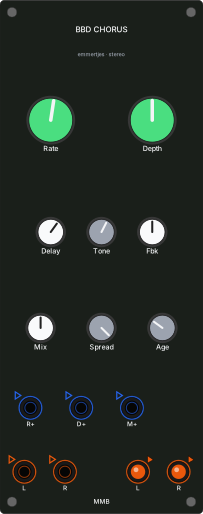
A stereo chorus and flanger in the style of the bucket-brigade (BBD) units of the late seventies, the CE-1 and Dimension family. A short delay is pulled back and forth by a slow LFO; the copy, slightly out of tune with the original, is mixed back in. Delay sets the character: 2–6 ms flanges, 8–20 ms is chorus, above 20 ms it becomes doubling.
Put it after a voice or a whole mix. A mono input gives a stereo output; with a cable in R it stays true stereo. Spread at 1 runs the two sides in opposite phase, the wide Dimension image; Fbk, positive or negative, pushes it towards a flanger.
Controls
| Control | Range | Default | What it does |
|---|---|---|---|
| Rate | 0.02 … 12 Hz | 0.6 | How fast the LFO sweeps the delay, in Hz. |
| Depth | 0 … 1 | 0.5 | How far the delay swings: up to ±60 % of Delay. |
| Delay | 0.5 … 40 ms | 8 | The centre delay: 2–6 ms flanger, 8–20 ms chorus, above 20 ms doubling. |
| Fbk | -0.95 … 0.95 | 0 | Feeds the output back in, positive or negative, for the flanger side. |
| Mix | 0 … 1 | 0.5 | How much chorus is mixed with the dry sound. |
| Spread | 0 … 1 | 1 | Phase offset of the right LFO: 0 = mono, 1 = opposite phase, the widest image. |
| Age | 0 … 1 | 0.3 | Clock noise and a harder-working compander: an older, dirtier unit. |
| Tone | 0 … 1 | 0.6 | Bandwidth of the bucket brigade: 0 = about 2 kHz (dull), 1 = 12 kHz. |
Ports
| Port | Direction | Signal | What it carries |
|---|---|---|---|
| R+ | in | cv | Replaces the Rate knob while patched; the value is read in Hz. |
| D+ | in | cv | Replaces the Depth knob while patched (0 to 1). |
| M+ | in | cv | Replaces the Mix knob while patched (0 to 1). |
| L | in | audio | Audio input, left (or mono). |
| R | in | audio | Audio input, right; leave it empty for mono in, stereo out. |
| L | out | audio | Audio output, left. |
| R | out | audio | Audio output, right. |
How it works
Each side is a delay line of up to 40 ms read by a triangle LFO with slightly rounded turning points, so they do not click. The LFO swings the delay by up to ±60 % of the centre value. The right side runs the same LFO shifted by half a cycle times Spread.
The sound of a BBD lives in the chain around the delay, and that is what is modelled: a low-pass filter at the input and the output (the anti-aliasing filters of a real chip; Tone sets their bandwidth from about 2 kHz to 12 kHz), a soft compander that saturates when you play hard, and a little clock noise. Age adds that noise and makes the compander work harder. The same C++ kernel runs on the Teensy and in the browser.
Runs on
- Teensy 4.1 (the MusicBrain Brain): about 3.8 % CPU per instance (one note, default settings), measured on firmware 0.5.108.
- The browser: the editor's simulator runs the same C++ code as WebAssembly, so what you hear while patching is what the Brain plays.
Try it
Patches to play (open them in the editor from their page): MS-20-ed Hammond w/ Tape Delay & Lesley.
In the editor's example set: 🎺 CS-80 brass (aftertouch), 🌊 DX7 + BBD chorus, 🎺 CS-80 brass ×4.
Editor: https://editor.musicbrain.nl
Sources & licences
- Modelled on the behaviour of BBD chorus units of the CE-1 / Dimension family; no circuit simulation and no third-party code.
- Own kernel
mmb_dsp/bbd_chorus.h, MIT licence.
Versions
- 0.5.71: first version (effects batch with stereo tape echo, digital echo, ring modulator and octaver).