Component
Acid bass
v0.5.108
A 303-style bass voice: turn Cutoff, Reso and Env mod while it plays.
Software v0.5.108
Overview
A 303-style bass voice: turn Cutoff, Reso and Env mod while it plays.
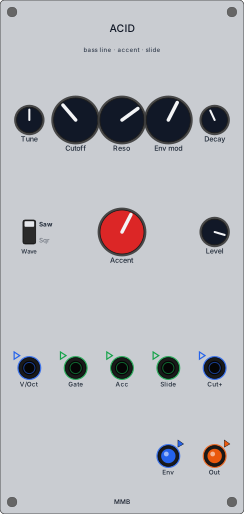
A complete bass voice in the style of the Roland TB-303: one oscillator (saw or square), a four-pole low-pass filter that squeals but never quite oscillates on its own, and a filter envelope with only a decay. Play it from a sequencer (V/Oct and Gate) and turn Cutoff, Reso and Env mod while it runs: that is the instrument.
The character comes from two gate inputs that are read at the start of each note. Acc (accent) makes the note louder, its filter envelope shorter and wider, and successive accents build up so the filter climbs higher note by note. Slide makes the pitch glide to the next note in about 60 ms without a new attack; keep Slide high across the note boundary. Drive Acc and Slide from a second sequencer row, Euclid, Turing or Branches and the line varies itself. Tune is in semitones; a bass line usually wants −12 or −24.
Controls
| Control | Range | Default | What it does |
|---|---|---|---|
| Tune | -24 … 24 semi | 0 | Pitch offset in semitones; a bass line usually wants −12 or −24. |
| Cutoff | 0 … 1 | 0.35 | Filter: the brightness. |
| Reso | 0 … 1 | 0.7 | Filter: the squelch. |
| Env mod | 0 … 1 | 0.6 | How much the filter opens on each note. |
| Decay | 0.1 … 3 s | 0.4 | How quickly the filter closes again. |
| Wave | Saw / Sqr | Saw | Saw or square. |
| Accent | 0 … 1 | 0.6 | How much accented notes jump out. |
| Level | 0 … 1 | 0.8 | Output level. |
Ports
| Port | Direction | Signal | What it carries |
|---|---|---|---|
| V/Oct | in | cv | Pitch, 1 V per octave around middle C. |
| Gate | in | gate | Note on and off. |
| Acc | in | gate | High at the start of a note: the note is accented. |
| Slide | in | gate | High: glide to the next note without a new attack. |
| Cut+ | in | cv | Cutoff modulation: ±1 is ±4 octaves. |
| Env | out | cv | The filter envelope as CV, 0 … 1. |
| Out | out | audio | The bass voice. |
How it works
The oscillator uses polyBLEP to keep the saw and square free of aliasing. The filter is a four-pole ladder with a saturating (tanh) feedback loop and a high-pass in that loop, so the resonance thins out in the bass and the filter stops just short of self-oscillation. It runs at twice the sample rate.
Cutoff sweeps from 60 Hz to about 5 kHz; the envelope, the accent and the Cut+ input (±1 = ±4 octaves) add to that. An accented note gets a fixed 0.2 s filter decay. A second, slower circuit adds up successive accents and charges more slowly as Reso goes up, which gives the rising "wow" of an accent run. Env outputs the filter envelope as a CV.
This is our own model after the topology of the original, tuned by ear, not a component-by-component simulation.
Runs on
- Teensy 4.1 (the MusicBrain Brain): about 7.1 % CPU per instance (one note, default settings), measured on firmware 0.5.108.
- The browser: the editor's simulator runs the same C++ code as WebAssembly, so what you hear while patching is what the Brain plays.
Try it
Patches to play (open them in the editor from their page): Acid jam.
In the editor's example set: 🧪 Acid (303-stijl bas), 🧪 Acid jam (Clock + Euclid + Chaos), 🧬 Acid jam.
Editor: https://editor.musicbrain.nl
Sources & licences
- Modelled on the Roland TB-303 Bass Line.
- Own kernel
mmb_dsp/acid.h, shared by the Brain and the browser, MIT licence.
Versions
- 0.5.95: first version.