Component
FPGA voice
v0.3.0
Eight-voice physical-modeling synth voice on an FPGA, played by Cortex as a regular instrument on the SPI bus. Each voice is a Karplus-Strong string with a morphing wavetable exciter, running through an MS-20-style filter with diode saturation and drive. Pitch, gate and filter arrive as per-voice CV over the established frame protocol, so to the brain it looks no different from an analog module — it just happens to be 20 thousand logic cells pretending to be strings.
Used in
Software v0.3.0
pinned by cortex v0.3 · stable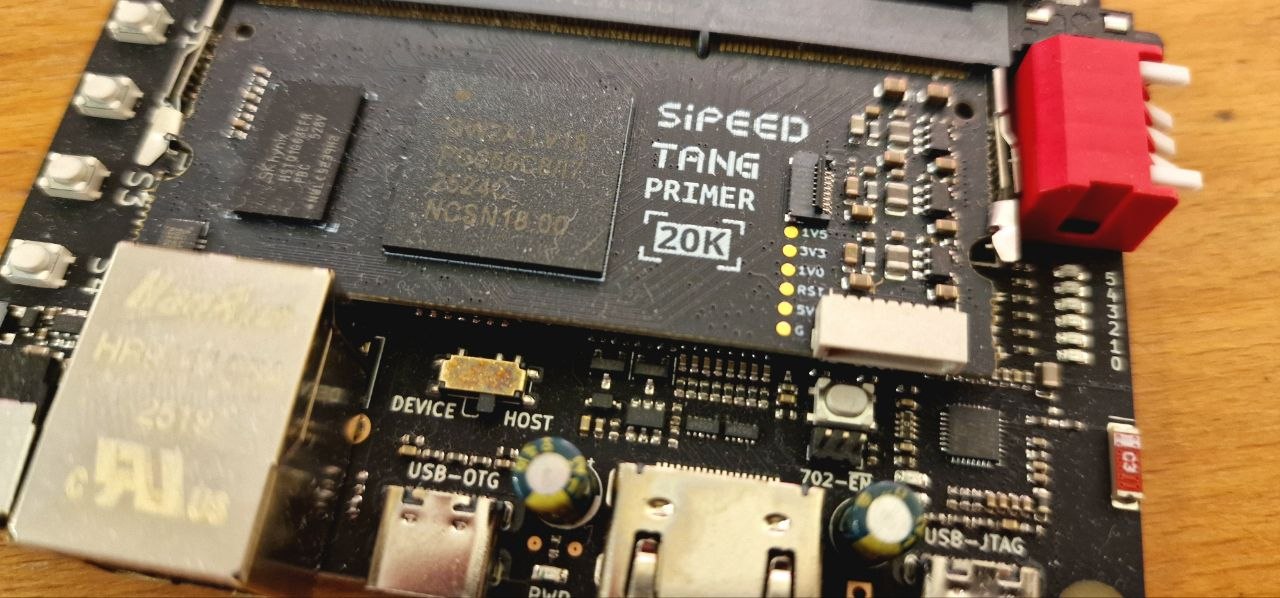
Overview
An eight-voice physical-modeling instrument in an FPGA (Sipeed Tang Primer 20K, Gowin GW2A-18), attached to Cortex as an SPI-slave instrument. The brain does MIDI-in and voice allocation and sends per-voice pitch CV, gate and filter CV over the frame bus; the FPGA turns them into sound and plays it out of the dock's stereo DAC.
Voice architecture
Each of the eight voices is a Karplus-Strong string — a delay line with a damped feedback loop — excited by a morphing wavetable instead of plain noise. The exciter tables blend under CV control, which shifts the pluck from soft mallet to glassy attack. All eight voices are time-multiplexed through one shared datapath at 48 kHz, in Q12.20 fixed point.
MS-20-style filter
The filter is a Chamberlin state-variable core with the MS-20's character bolted on: a tanh lookup table saturates the resonance feedback the way the original's diode clipper does, a drive parameter pushes the input into that same curve, and the core runs at 2x oversampling to keep aliasing down. Cutoff, resonance and drive are all per-voice CV targets. A four-level wah mode sweeps the filter for expression work.
Cortex integration
The module speaks the standard frame protocol (framed SPI with CRC-16, CvSet/GateSet opcodes) as a type-1 pitch module: pitch arrives as plain 1 V/oct-style CV code, not as MIDI notes, so the FPGA is interchangeable with an analog oscillator bank from the allocator's point of view. Slots are grouped in blocks of eight per parameter — pitch, gate, cutoff, resonance, drive, exciter morph — one slot per voice.
Hardware
Runs on the Sipeed Tang Primer 20K (27 MHz clock, GW2A-LV18 with 828 Kb block RAM and 48 multipliers) sitting on its dock, which provides the PT8211 stereo DAC and 3.5 mm jack. The design uses 13% of the logic and half the multipliers; the wavetables fill 81% of the block RAM, which is the resource that decides what fits.
Next
A port to a Spartan-7 board (Arty S7-50) is in progress for the bigger version: 16+ voices, an FDN reverb and a DDR3-backed tape echo, with the Tang Primer staying on as the compact voice card.